The American Red Cross is busy 365 days a year, 24 hours a day turning compassion into action.
When Siskiyou County’s McKinney Fire broke out, the Red Cross was called upon to open an evacuation shelter in Yreka. Within just a few hours, the doors were open.
Once evacuation orders were issued in Yreka, the Red Cross relocated the shelter to the Weed Community Center.
Barbara Leper and her husband are guests at the Red Cross shelter in Weed.
Barbara Leper, 78, and her husband are at the shelter in Weed because they are once again under the threat of losing everything all over again. “Last year we had to run for our lives when our home in Happy Camp burned to the ground in just a few minutes,” Leper said.
The Lepers have lived in beautiful Siskiyou County for nearly 30 years. Regardless of the continuum of wildfires, they are planning to stay put in the Weed community. “We just love it here, it’s our home,” Leper said.
The Red Cross was there for the Lepers last year. Leper shared how the Red Cross helped them along with temporary housing and the essential items they needed.
“The Red Cross kept helping us along the way,” Leper said. “We received another $500 gift certificate in December for food and gas.”
Consider supporting Red Cross disaster relief efforts by visiting redcross.org/donate.
Strong relationships with community partners are pivotal in caring for those who need assistance during a disaster. Volunteers from the Salvation Army in Redding have been serving up great meals to dozens of McKinney Fire evacuees. Pictured are Joy Wegner (top left), Teri Lewis (top right), Dorinda Cox (bottom left), and Steven Brooks (bottom right).
McKinney Fire evacuees Harlene (left) and Burt (right) hanging out in the women’s quarters at the Weed, CA shelter. Sharing stories and encouragement, both said they are grateful for the shelter. Harlene lost everything in the fire. Burt evacuated as a precaution.
A big thank you to Cowabunga Ice Cream Truck out of Valley Springs for delivering some frozen sweet treats to our shelter in San Andreas this week.
During a wildfire, when our shelter guests have lost so much, something as simple as ice cream can sure boost their spirits!
Cowabunga’s owners posted on Facebook: “A great night visiting evacuees and volunteers in San Andreas. Next stop Amador! Passing out free ice cream for those who have been displaced and those that need a smile on their faces. Fun night.”
Thank you for caring, Cowabunga!
For information on how you can support the American Red Cross during times of disaster, visit redcross.org/donate.
Michelle Symington and Shelley Royce evacuated from their homes in Amador County to escape the Electra Fire burning in Amador and Calaveras counties.
They are staying with their beloved dogs and cat on at the Red Cross shelter located at the Italian Picnic Grounds in Sutter Creek. There, they are provided food, snacks, beverages, health services and a bevy of other support.
“This is the first time we’ve had to evacuate due to a disaster. It’s a tough time for us,” Michelle said. “I’m worried about my husband’s health condition, but he’s being cared for here.
“We’d much rather be home watching ‘Downton Abbey’ but, on the bright side, I’ve met so many people here who have been so kind and helpful. I like to help people so have decided to check into becoming a Red Cross volunteer”.
If you would like to support Red Cross disaster relief efforts, visit redcross.org/donate and click on “Disaster Relief” in the dropdown menu.
By Kim Mailes, American Red Cross public affairs volunteer
For Frieda Ingram, right now “home” is a cot in the American Red Cross emergency shelter in Reno, Nevada. Despite being evacuated from the South Lake Tahoe when wildfires approached her apartment, she’s all smiles and maintains a positive attitude. This is just another bump in a long road that’s been filled with obstacles.
“I’m so grateful for the Red Cross,” she said. “I know I’ll be safe here until this is over.”
By Barbara Wood, Red Cross Public Affairs Volunteer
It’s been more than two weeks since Josephine Hernandez and her six children had 30 minutes to pack their car and to evacuate the looming Caldor Fire, but on Sept. 1 as the family awaited news that they could return to their Pollock Pines home, the children joyfully played on a lawn at the Green Valley Church Red Cross shelter in Placerville.
Five of Josephine Hernandez’ six children cool off in a kiddie pool outside the room at the Red Cross shelter in the Green Valley Church in Placerville that was their home for more than two weeks as they awaited word that they could return to their home in Pollock Pines. They are (l-r) Adriana, 13; Briana, 13; Camille, 6; Daniel, 2 and Steven, 4. Photo by Barbara Wood/American Red Cross
Hernandez and her six children spent the first two nights after their Aug. 17 evacuation sleeping very close together in the family’s Suburban. Then they heard about the shelter that had been opened at the Green Valley Church in Placerville. After a few more nights in the church parking in two borrowed tents, the family was moved into a classroom at the church.
“It’s been terrible,” Hernandez said. “More than a challenge.”
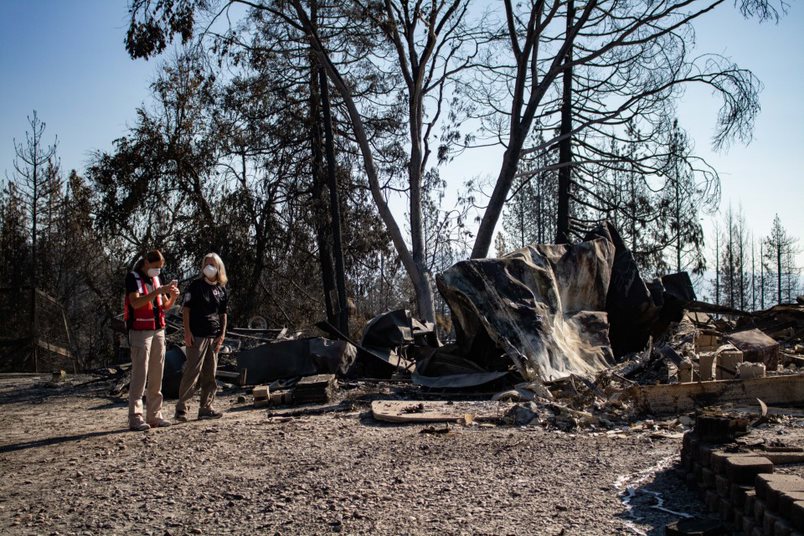
Driving into the mountains towards Berry Creek, the world becomes monochrome. Everything on the ground is blackened, broken up by patches of white ash. Where structures once stood—homes, garages, sheds, and outbuildings—there are now scorches of earth dotted with twisted metal and pools of plastic. It’s eerily quiet. With nothing alive in the immediate area and no leaves for wind to rustle, the only sound is buzzing flies to add to the apocalyptic feel of the scene ahead.
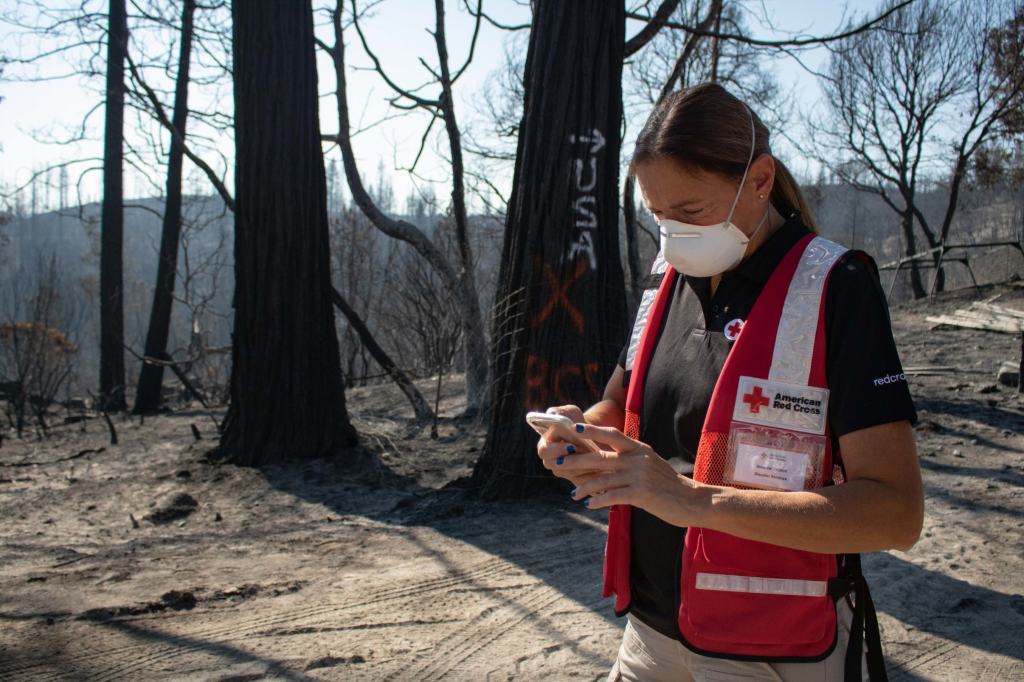
Disaster Assessment duo Diane Sargent and Suzanne Reibson are unphased. Having flown into California from Buffalo, New York, this team know what they’re looking for and get right to work.
Assessing what’s known as a “hot spot”, they quickly make their way around the property. The owners have already called the Red Cross for assistance, and Diane and Suzanne are checking for the livability of the house on the address. They also note other properties they pass, trying to make an assessment from the end of the driveway when there is no one to ask if they need further assistance—striving to ensure that no one is left in need.
It’s clear there is no possibility of living in these homes in Berry Creek anymore.
No stranger to destruction, Diane has been a volunteer for the American Red Cross for nineteen years. She joined right after 9/11 after seeing the Red Cross response first-hand. Over 80 deployments later, she is an expert in disaster assessment and mentors Suzanne who has been a volunteer for about three years.
As Diane navigates the rutted dirt roads, Suzanne enters data on the properties they’ve visited when there is cell reception and follows the paper map to track their route through the mountains when there’s not.
Coming down from Berry Creek for a quick gas stop, Diane and Suzanne are already plotting their next route. An elderly woman who is currently living in a tent near her daughter’s mobile home must soon vacate the tent, so she called the Red Cross for help.
And help has arrived in the form of small, wiry, tattooed Diane and vivacious Suzanne with her blue-polished fingernails saying, “Hi, honey! How are you doing today? We’re just heading out to your house, can you tell us where to turn again?”
To help people who’ve lost their homes to the wildfires, visit redcross.org/donate, call 800 RED CROSS, or text CAWILDFIRES to 90999 to make a $10 donation. You can also become a volunteer like Diane and Suzanne by visiting redcross.org/volunteer.
Bill Hart has the kind of voice that makes you feel like everything is going to be OK. This is ideal for a man in his position—Spiritual Care Lead for the American Red Cross Gold Country Region as we provide comfort and care to people displaced by the wildfires in northern California.
Bill Hart, Disaster Spiritual Care Lead
He has filled the Disaster Spiritual Care (DSC) role for the Gold Country Region of the Red Cross since September 2016. “Spiritual care is one part of a three-legged stool, along with mental health and health services. Together we form individual disaster care. We try to look at the mind, body and soul and provide care to all of those areas.”
Bill has been very active responding to the fires and earthquakes that happen across California, notably spending 89 days working on the Camp Fire response and currently providing support to disaster relief operations in northern areas of the state. “Wildfire response has become kind of a specialty,” he said. “In a wildfire, when everything is burnt down to ashes, recovery can feel insurmountable. We want them to start telling their story and moving towards hope.”
Bill’s path into the Red Cross is a windy one. After a couple of personal losses involving a family member in hospice, Bill recognized that primary care givers do not often get much support as they are losing loved ones. Finding a group that provides exactly that kind of care led Bill to become a hospital chaplain, and from there a chaplain that serves the armed forces. A Methodist minister, he met a Red Cross spiritual care volunteer through a mutual pastor friend who asked if he might be interested in volunteering as a Red Cross spiritual care provider.
A local to northern California, Bill lives in a small town in the Sierra Mountains about halfway between Sacramento and Reno. He has been ready to evacuate himself in years past, especially when the Bear River canyon was on fire within a few miles of his home. “It got pretty exciting for a while. They managed to keep it contained to the canyon, but we were all loaded up and watching it carefully,” he recalled.
Spiritual Care
The American Red Cross Spiritual Care team is trained to recognize the signs that someone may need assistance. They will look for someone who might be hoarding snacks at the shelters, or who is turning their cot area into their home. Agitation, pacing, isolation, anger, crying are also key indicators they watch for. “To do this job, you have to be ready for people to swear and yell at you and blame you for all their problems, and let them know we’re still there for them. But it’s really about getting to know the client. At the beginning of the operation we’re looking for the obvious signs. But then we get to know people and see how their moods may change. And people will come find us.”
Building relationships underpinned by trust is key to making a positive impact on people who have evacuated their homes. “Spiritual Care is in the shelters all day, every day. We don’t wait for people to come to us. We’re out in the shelters and spend mealtimes with people, or recreation time, and we’re constantly circulating around the grounds and other areas where people might be gathering, like the laundromat. And we start to get to know people, so they recognize us and we start building trust.”
A key time to be present with people is when they make the first trip back to their home after a wildfire. Bill says that people often stay in a shelter because they can’t go back home because there’s nothing left. “They often have a little spark of hope that somehow their house was spared, and that spark doesn’t go out until they’re standing in the middle of the ashes of their house.”
One case that really stands out to Bill is that of a ninety-two-year-old man standing in the middle of his driveway, surrounded by the remains of his home after a catastrophic wildfire. He had moved into that house four years previously with his wife who then passed away from cancer. Having outlived his spouse and children and then losing his home to a wildfire, he worried that there would be nothing on earth left to prove he had ever existed.
With fires burning regularly across the state, Bill has seen some of the same faces in Red Cross shelters after different evacuations. “I encountered numerous individuals who have repeatedly evacuated the last couple of years, and several that have just about finished with rebuilding. Some know they’ve lost their new homes. I’ve remembered some, some remember me, all remember the Red Cross was there when they needed us. One man I met in Redding the other day was pretty sure he’d lost his home again but stopped by [the shelter] to try to make a cash donation to help others*.”
COVID Precautions
As important as physical comfort often is in spiritual care, COVID-19 precautions have made it nearly impossible to provide a shoulder to lean on, a hug, or a hand to hold. “People will reach towards us to be hugged, and it’s very difficult to say no because we’ve worked to get them to open up. We don’t want to maintain social distancing. We want to be there to hold your hand and be a shoulder. But we just have to keep everyone safe.” Bill explained that for a while the spiritual care team tried to work over the phone, but it was just not as effective as face to face. The connection between volunteer and evacuee is much more robust when they are in-person.
Most importantly for Bill is that people affected by disasters don’t let the word ‘spiritual’ keep them from seeking care. “We’re not the religious group that people might think of. We’re there for everybody. If it’s not something that we can help with, we find someone who can. We’re just there to inspire hope.”
*We are incredibly grateful to members of the public whose generosity and impulse to help lead them to attempt making cash donations. To ensure financial transparency and responsible use of the donor dollar, we cannot accept cash donations and ask that all donations be made online at redcross.org/donate or by texting REDCROSS to 90999.



 Gold Country News and Notes