
 Going to the California State Fair? If you buy your tickets online here, $1 of every ticket sold will go to the American Red Cross Gold Country Region!
Thank you for your support!
Going to the California State Fair? If you buy your tickets online here, $1 of every ticket sold will go to the American Red Cross Gold Country Region!
Thank you for your support!


Red Cross volunteers had a busy day with our Blue Shield partners in Lodi today! Not only did Blue Shield host an onsite blood drive, but employees also sat down with us to build 100 first aid kits and take part in a session for the Missing Maps project.
What is Missing Maps?
Imagine if your town had suffered catastrophic damage in a storm but emergency responders and aid workers couldn’t get there to help because your community wasn’t on any maps.
While this may seen strange to Westerners, it’s a real problem in other parts of the world.
To help get relief into people’s hands, the American Red Cross and partner organizations such as Blue Shield have joined with Missing Maps. Using OpenStreetMap, volunteers have put millions of people from high-risk countries on the map since 2014.
This makes a lifesaving difference for disaster workers combating deadly health crises like the 2014 Ebola outbreak in West Africa. And when a 7.8-magnitude earthquake ravaged parts of Nepal in 2015, volunteers worldwide sprang into action to map affected communities and roads to support relief efforts on the ground.
But much work still lies ahead to put more families in the world’s most vulnerable communities on the map—before disaster strikes.
You can help too! All you need is a computer and an internet connection. Volunteer at home, attend a mapathon or host one with family and friends.
If you are intersted in volunteering with the American Red Cross or to make a donation, visit redcross.org or call 1-800-RED-CROSS.

An earthquake is a sudden, rapid shaking of the earth caused by the shifting of rock beneath the earth’s surface. They strike without warning, at any time of year, day or night.
Forty-five U.S. states and territories are at moderate to very high risk of earthquakes.
The American Red Cross is sharing the following tips to keep your loved ones safe:
Protecting Your Family
o Find an online NOAA radio station.
o Search for a NOAA radio app in the Apple Store or Google Play.
o Purchase a battery-powered or hand-crank NOAA radio at shoptheredcross.org.
Protecting Pets & Animals
Protecting Your Home
During an Earthquake
Staying Safe Indoors
o Move as little as possible – most injuries during earthquakes occur because of people moving around, falling and suffering sprains, fractures and head injuries.
o Try to protect your head and torso.
o If you must leave a building after the shaking stops, use stairs rather than an elevator in case of aftershocks, power outages or other damage.
Staying Safe Outdoors
o Stay inside with your seatbelt fastened until the shaking stops.
o After the shaking has stopped, drive on carefully, avoiding bridges and ramps that may have been damaged.
o If a power line falls on your vehicle, do not get out. Wait for assistance.
After an Earthquake
If you do nothing else:
Caring for Yourself & Loved Ones
Returning Home Safely
Between her full time job as a Kaiser Advice Nurse and her meticulous care of an ambitious garden, Patty Harris of Sacramento finds time to volunteer. One of Patty’s projects is sharing her passion for nursing by conducting presentations to young girls in schools.
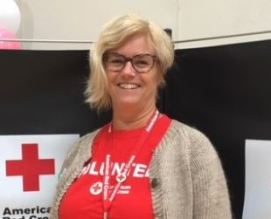 Having energy to do even more, Patty joined American Red Cross one year ago as a Trainer and Donor Ambassador; assisting Sacramento-area volunteers through Donor Ambassador trainings.
At a recent Stockton high school blood drive, Patty said this about what stimulates her to volunteer. “It inspires me. It restores my faith in the goodness of people and how generous they are to give of their own bodies. Volunteering money is important but time is important as well. Volunteering is the backbone of our society.”
Prior to becoming a Donor Ambassador in 2017, John was well versed in the blood donation process.  John served in Vietnam with the US Army Medical Corps. It was there that he grew aware of the life saving gift that was donation of blood. He promised himself that, if he didn’t return from ‘Nam in a body bag, he would return committed to becoming a blood donor. Since then, John has donated over 200 units.
“Dr. John Giehl” was a psychologist with Tracy Unified School District for 33 years. His goal, upon retirement, was to continue learning and be of service. “My experience with American Red Cross aligns nicely with these endeavors,” he says. “While enjoying interaction with both staff and fellow volunteers, I really appreciate my time in conversation with blood donors. Our lively post-donation discourse can morph in tone from solemn to gleeful. Each person has a story.”

The American Red Cross sheltered 12 people Sunday night after a ceiling collapsed at a Stockton apartment complex.
Damage at the Meadow Green Apartments was caused by excessive water after weekend rains, according to local media reports.
Anyone who was directly affected by the incident who needs a place to stay is welcome at the shelter which is located at the Arnold Rue Community Center, 5758 Lorraine Ave, Stockton, CA, 95210.
The Red Cross provides for immediate needs at our shelters, including a place to sleep, food and beverages.
You can support the Red Cross by making a donation at redcross.org.

This message is from Chris Hrouda, President, Red Cross Biomedical Services:
I am reaching out to alert you that last month the Red Cross collected approximately 11,500 fewer type O blood donations than needed—causing these donations to be distributed to hospitals faster than they are coming in. As such, the American Red Cross is issuing a critical shortage appeal for type O blood donations, nationwide on Tuesday, May 14.
This shortage is particularly relevant given that May is Trauma Awareness Month and the unique role type O blood donations play in the treatment of trauma patients. Right now, the Red Cross has just six units of type O blood available for every 100,000 people, but more than double that amount is needed every day.
When Seconds Count—Type O is Critical
As you know, type O blood is the most needed blood group by hospitals but is often in short supply. Type O negative is the universal blood type and what emergency room personnel reach for when there’s not enough time to determine a patient’s blood type in the most serious situations.
According to Dr. Jennifer Andrews, a pediatric hematologist who oversees the blood bank at Vanderbilt University Medical Center in Nashville, “O negative is like liquid gold to us in the blood bank and especially to our colleagues in the trauma service. Oftentimes trauma victims are brought to our hospital in extremis dying of their injuries and we don’t have enough time to get their blood type here in our blood bank. So very commonly trauma centers, across the U.S. will give them O negative blood red blood cells when we don’t know their blood type because that’s compatible with every blood type.”
How You Can Help
Schedule a blood donation appointment today by using the Red Cross Blood Donor App, visiting RedCrossBlood.org or saying “Alexa, schedule a blood donation appointment.” While type O is critically needed, platelet and blood donors of all types are urged to give now to help trauma patients and others who depend on lifesaving blood products.
We also recognize that not everyone is able to give and ask for your help in recruiting a family member or friend to give on your behalf, spreading the word on social media, or volunteering at a local blood drive. Interested individuals can also sign up to host a blood drive in the months ahead.
We all can play an important role in helping to ensure a sufficient blood supply for patients who are counting on us. Thank you.
The American Red Cross Pillowcase Project is a free, interactive preparedness program designed for youth ages 8 to 11. The program aims to increase awareness and understanding of natural hazards and teaches safety, emotional coping skills, and personal preparedness.
Through instructor-led presentations, students learn the best ways to stay safe and how to create their own emergency supply kits by packing essential items in a pillowcase for easy transport during a disaster. Students also have the opportunity to decorate and personalize their pillowcases and share what they’ve learned with friends and family.
The curriculum meets many of the Common Core State Standards for grades three to five.
You may request The Pillowcase Project one-hour presentation for your school or youth program by selecting The Pillowcase Project here.
The Gold Country Region is also always looking for volunteers to lead Pillowcase Project presentations. Go to redcross.org to sign up and help!
Hundreds of volunteers and community partners will join the American Red Cross this month for our annual signature event – Sound the Alarm – to install 1,000 free smoke alarms in seven cities throughout the Gold Country Region.
Our goal is to reduce the number of deaths and injuries associated with home fires by 25% by 2020. It’s an endeavor we could not undertake without the generous support of community partners.
Thank you!

Sound the Alarm is May 4! Register to volunteer at http://soundthealarm.org or make a donation for @bigdayofgiving at http://bigdayofgiving.org/americanredcross.


 Gold Country News and Notes