Bill Before Legislature Would Allow Vet Care at Emergency Shelters

12-year-old yellow lab Woody Wyatt and his adoptive mom Lilly.

Editorial by Kevin O”Neal and Christy Woods

Katrina. Ten years ago this month that name became forever linked with tragic scenes of devastated residents, flooded homes and businesses, harried evacuations, and heroic rescues throughout the Gulf States. Merciless in its carnage, Hurricane Katrina became one of the deadliest and most expensive natural disasters in our nation’s history.

Amidst enormous disaster response efforts mounted by communities and government agencies, a simultaneous animal rescue operation was being undertaken by emergency responders and animal welfare groups from Louisiana and across the country. They mobilized quickly to save and care for thousands of companion animals imperiled by the storm.

Despite the massive effort, Katrina’s devastation exposed many flaws in the way we were responding to animals during natural disasters, and groups like the ASPCA and other animal welfare responders immediately dedicated themselves to improving policies and processes to save more lives. We’ve come a long way in the past ten years, but there’s still much work to be done.

Some of that work is happening right now in the state of California — no stranger to natural disasters — where the ASPCA and the American Red Cross are working to pass AB 317, legislation that will improve California’s emergency response capabilities. Current state law only allows veterinary care of animals at facilities with a premise permit, and obtaining such a permit in the midst of a crisis can create life-threatening delays. AB 317 exempts emergency shelters from the permit requirement during state emergencies, though it requires those shelters to conform to all standards of care expected of permanent veterinary facilities.

Our experience during Katrina confirms the importance of these temporary animal shelters. According to a Fritz Institute poll, 44 percent of New Orleans residents delayed or chose not to evacuate the city because they refused to leave their pets behind. A similar nationwide poll by Lake Research Partners on behalf of the ASPCA found 42 percent of Americans across the country stating they would also not evacuate without their pets. With pets, owners, and emergency responders all at such great risk, accessible emergency shelters are critical to saving lives.

While the rescue of animals in the initial response to a disaster is critical, reuniting animals with their owners after a disaster is equally important. In the aftermath of Katrina, roughly 15 to 20 percent of animals were reunited with their owners.

Establishing emergency animal shelters near Red Cross shelters is a key component to increasing the return of animals to their families, and both the Red Cross and ASPCA strive to co-locate shelters whenever possible. AB 317 would facilitate this process by making the establishment of fully-qualified emergency shelters easier and faster.

This is why the Red Cross joins us in enthusiastically supporting AB 317, which currently needs one more critical vote before heading to the Governor for his consideration.

Thanks to the lessons of Katrina, animals are better protected during natural disasters now than they’ve ever been, but California can play an important role in ensuring and enhancing those protections with AB 317, which serves the best interests of California pets and people.  We thank Assemblyman Brian Maienschein (D-San Diego) for his leadership in recognizing the need for this legislation, and we urge the Senate to take decisive action to pass this bill.

Kevin O’NeillChristy WoodsKevin O’Neill is senior director of government relations for the ASPCA/Western region. Christy Woods is director of state government relations and external affairs for the American Red Cross.

Huge ‘Thank you’ to Flowers Food Bakery

The wonderful team at Flowers Food Bakery, in Modesto, has done it again, and this time we want to extend our deepest appreciation to them for all of the generous gifts and services that they have and continue to provide.

Thursday, August 6th, to help survivors of the Mad River and Fork Fire Complexes, Flowers Food made a special delivery to our shelters that were open in Trinity County. Breakfast and snack items were served to everyone!

Last year during the King, Boles and Applegate fires the wonderful team went above and beyond to bring the community together during their time of need.

They delivered product to our emergency command center in Sacramento and to our shelter in Applegate. They even went as far as to host an amazing barbecue lunch for the volunteers and staff!

These acts of kindness fall right in line with the American Red Cross values; compassionate, collaborative, creative, credible and committed! We are truly grateful!

International Youth Day: Carolyn’s Powerful Survival Story

August 12 is International Youth Day! And the American Red Cross is celebrating our young partners like Carolyn Strzalka, President of the Red Cross Club at the University of Michigan. Carolyn is a blood recipient, a donor and a Red Cross volunteer.

Here’s Carolyn’s Inspiring Story:

Carolyn-Strzalka In high school I was an active student. I volunteered regularly at a local animal shelter and organized local food donation drives in addition to working hard on my studies. As varsity soccer captain, I ate healthy and exercised, making sure to take care of my health. So when I turned 18 and started experiencing sharp abdominal pains I knew something was not right.

When my doctor told me that I needed to have my gall bladder removed two days before moving into my college dorm I was nervous I would miss out on all the welcome week activities. As a stubborn 18 year old, I adamantly told him that after my cholecystectomy I would be going off to college. He explained to me the surgery was an out-patient surgery and I should be recovered enough to partake in any non-strenuous activities. But the day after I moved into my dorm room I knew something was not right. After not being able to keep any food down and almost fainting walking back to my dorm room I called my mom and asked her to take me to the hospital.

In the emergency room, the physicians told my parents that there was a very low chance that I would survive. I had been internally bleeding into my stomach for 3 days and my red blood cell levels were at a third of what they should have been. He suggested I receive two blood transfusions, but cautioned my parents that it may already be too late. Fortunately, the blood transfusions saved my life.

I am beyond thankful for the blood donors whose donations have allowed me to be alive today. These donors have a special place in my heart because I have type O negative blood and can only receive blood from other type O negative people.

After this experience I wanted to give back to blood donors who helped save lives like mine. However, after receiving a blood transfusion you are not able to donate blood for a year. So I began volunteering at blood drives to let people know how much their donation meant to people like me. While volunteering I got to hear inspiring stories about why other people donated blood, including stories from people who donate blood every 56 days. After experiencing the need for blood donations first hand, I now am inspired to donate every 56 days as well.

How to Get Involved:

Join Carolyn by choosing to make a difference in your community this summer with the Red Cross, either through blood donation, taking a babysitting class or volunteering. You can find more ways to get involved at RedCrossYouth.org. #ChooseYourDay

Dakota Bradley Named Ambassador for Red Cross Fire Mission

After losing his childhood home in a house fire at the age of 15, singer/songwriter Dakota Bradley has a personal connection to those who know all too well what the fire takes from people.  Growing up in St. Louis, MO, Bradley moved to Nashville, TN at the age of 16 after his family lost everything in a house fire. This life-changing experience is the inspiration behind Bradley’s passion to partner with the American Red Cross and to serve as an Ambassador for our home fire campaign to reduce fire deaths and injuries by 25%.

“Losing my home in a fire was devastating. I am honored to partner with the American Red Cross in hopes to prevent similar tragedies, as well as a way to help fire victims,” says Bradley.

https://www.youtube.com/embed/o6cAgtjmccA“>

To kick off the yearlong giving campaign, Bradley will donate $0.50 to the American Red Cross for every digital purchase of “Name On It” sold between now and September 30, 2015. You can download his new single by visiting iTunes.  Your gift to Home Fire Relief enables the Red Cross to provide critical services to people impacted by home fires along with the lifesaving tools and information to support home fire prevention efforts.

https://www.youtube.com/embed/4k44KSPjcUs“>


Parents’ Gratitude for Blood Donors Highlights Summer Need

donate_blood_rotator_0

The American Red Cross has recently been in extra need of blood donors; the impact of blood donors has always proved instrumental in saving lives. As blood donations continue to decline this summer, the American Red Cross asks eligible donors to remember patients who are counting on the generosity of volunteers to roll up a sleeve and give. Without lifesaving blood, patients like 3-year-old Emily Stephenson wouldn’t be alive to share their stories.

Emily’s Story

Emily was only a few days old when her parents, Amy and Wayne Stephenson, learned she had a genetic blood disorder which causes severe anemia. To remain healthy, Emily will require blood transfusions every six to eight weeks until she is at least 10 years old. She’s already received blood more than 30 times.

“Blood donation is the bridge between life and death for Emily, but it is also so much more,” said Amy Stephenson. “It is learning to ride a bike, going to her first dance, earning a diploma and walking down an aisle someday.”

The Red Cross partnered with the Stephenson family in a special video to put a face on the importance of blood donation. In the video “Emily’s Story: A Letter from Mom and Dad,” the Stephensons want to express eternal gratitude for those who roll up a sleeve to help Emily live.

“The process of donation may appear to be filled with anonymity, but we see a name in every unit Emily receives during a transfusion,” said Amy Stephenson. “While we do not know the donor, we can see your heart and we appreciate you.”

Emily is one of many individuals who are in urgent need of blood; one donor can potentially save up to three lives from just one pint of blood.

The Red Cross has an urgent need for eligible blood donors with types O negative, B negative and A negative blood to give now to prevent an emergency situation. Type O negative is the universal blood type and can be transfused to patients with any blood type. Types A negative and B negative can be transfused to Rh positive or negative patients. Individuals with these blood types are urged to make and keep donation appointments as soon as possible to help replenish the blood supply.

Platelet donors and those with type AB blood are also continually needed to help ensure the shelves are stocked for patients in need. Platelets – a key clotting component of blood often needed by cancer patients, surgical patients and bone marrow recipients – must be transfused within five days of donation, so donations are always needed. Donors with type AB blood are urgently needed to restock the plasma supply. Type AB donors have the universal plasma type, which can be given to patients of all blood types.

Plasma is often needed for burn, trauma and clotting deficiency patients. Plasma can be collected during a blood or platelet donation.

Everyone is encouraged to give blood or platelets to help patients like Emily and replenish the blood supply. For more information or to schedule an appointment to donate blood, call 1-800-RED CROSS (1-800-733-2767) or visit redcrossblood.org. Donors can also use the Red Cross Blood Donor App, which is free and available for download now. It can be found in app stores by searching for American Red Cross, visiting redcross.org/apps or redcrossblood.org/bloodapp, or by texting BLOODAPP to 90999 for a direct link to download.

If you would like to donate in the Gold Country Region, visit Delta Blood Bank for information of when and where to donate.

Red Cross Renews Memorandum of Agreement with FEMA

Red_Cross_FEMA_Image

The American Red Cross has renewed its Memorandum of Agreement (MOA) with the Federal Emergency Management Agency (FEMA). The MOA is aimed at defining the overarching goals of the relationship between the two organizations. The Red Cross and FEMA last signed an MOA in 2010. The 2010 MOA focused on the collaboration between the two organizations in coordinating and delivering mass care services during disaster responses, and specifically on the Red Cross role as co-lead for mass care portion of Emergency Support Function-6, one of 15 Emergency Support Functions identified in the National Response Framework.

Since 2010, both FEMA and the Red Cross have enhanced their perspective to include all phases of the disaster cycle. In 2011, President Obama signed Presidential Policy Directive 8, which tasked FEMA with coordinating the production of National Planning Frameworks across the disaster cycle, including prevention, protection, mitigation, response, and recovery. In 2012, the Red Cross undertook a business process reengineering effort that resulted in alignment of its disaster preparedness, response, and recovery mission areas.

While the MOA still addresses the Red Cross co-lead role in Emergency Support Function-6, it also recognizes the important role the Red Cross plays in other Emergency Support Functions, Recovery Support Functions, and preparedness functions.

“This renewed MOA is a great reflection of Disaster Cycle Services and the goals and vision we set with re-engineering,” said Richard Reed, Senior Vice-President for Disaster Cycle Services.  “Working together with FEMA, we expanded our agreement to ensure our partnership covered the entire disaster cycle.  And we now have an agreement that is not only more strategic in nature but also speaks to the specifics of how our two organizations work together in preparedness, response and recovery.”

The MOA can be found on the Government MOU Index on The Exchange.  Contact the Emergency Management Coordination unit with questions.

Three Months Later: Red Cross Recovery Efforts Ongoing in Nepal

RC in Nepal


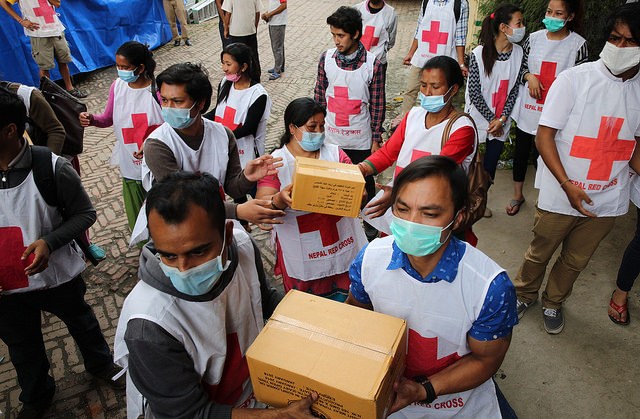
Three months have passed since the devastating earthquake rocked Nepal and its aftershocks shook surrounding locations. The Red Cross is still there providing relief and helping to rebuild.

On April 25, 2015 Nepal was severely impacted by a 7.8 magnitude earthquake, which took the lives of many and left others homeless and in a state of helplessness.

ifrc-nepal-earthquake-infographic
Click the Infographic to enlarge

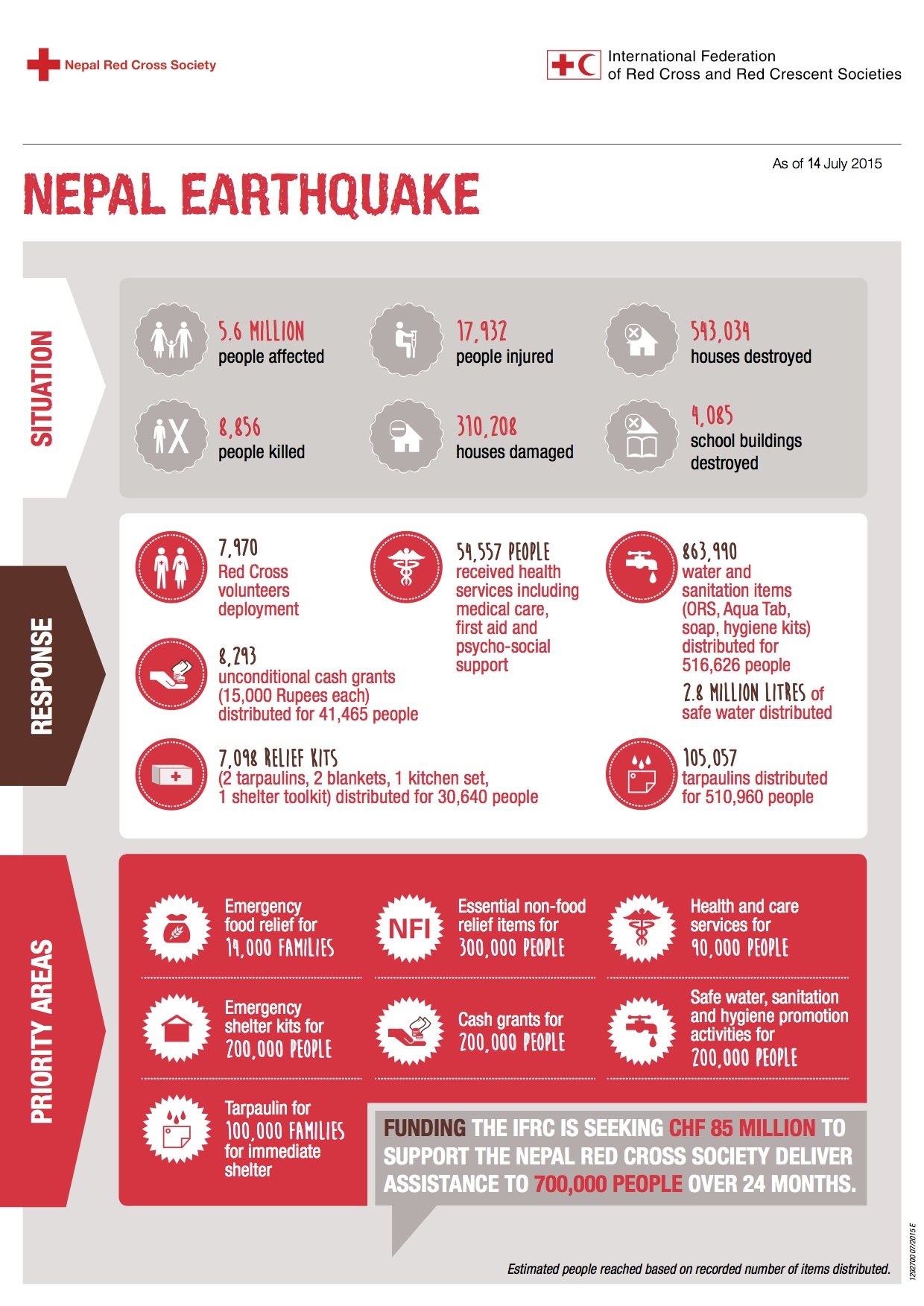
5.6 million people were affected, and of that number 17,932 people were injured and 8,856 people were killed. On top of the loss of lives 543,034 houses were destroyed.

To date nearly 8,000 Red Cross volunteers and staff have been deployed, and more than $13.6 million have been spent or committed to emergency relief and shelter and cash distribution.

With generous support and donations we have provided health services including medical care, first aid and psychosocial support; we’ve distributed more than 2.8 million liters of safe water, and more than 7,000 relief kits and hygiene kits have been distributed to Nepal survivors.

 This natural disaster was one of the largest to strike Nepal since 1934, and we will continue to do all that we can to assist with the restoration and rebuild of Nepal. Our primary areas of focus are food, water, shelter, health care and cash grants.

We are confident that we can extend our hand to aid in relief efforts.

Read some of the stories of the people impacted by this disaster: http://rdcrss.org/1E3Hjiy


Clara Barton For #TheNew10

Clara-Barton
Clara-Barton


The U.S. Department of the Treasury recently announced a redesign of the ten-dollar bill, to include a notable woman as the new face of the bill. Many minds at the Red Cross jumped immediately to our founder, Clara Barton. Here is a brief summary of who she was!

Barton is one of the most honored women in American history. She was a schoolteacher and also one of the first women to work for the federal government.

Clara-Barton
Clara-Barton

Risking her life, Barton offered support, food and supplies to soldiers who were fighting in the Civil War. In 1870, during the Franco-Prussian War, Barton used her expertise to help distribute relief supplies and set up stations where work could be done.

On May 21, 1881, Barton and a group of like-minded individuals founded the American Association of the Red Cross, and she led it for 23 years! The Red Cross received its first congressional charter in 1900 and a second in 1905.


Since then Barton published several books pertaining to the American Red Cross. She had a special interest for things that would promote a better future for all like education, prison reform, women’s suffrage, civil rights, and even spiritualism.


Barton has contributed so much to so many, and her devout love for humanity along with her willingness to serve others was revealed time and time again through her actions, and resulted in enough achievements to fill several ordinary lifetimes.


For more information on the history of Clara Barton visit, http://rdcrss.org/1jMbimy

A Full Circle Moment

Thanks to Fox40 for sharing the work that we do at the American Red Cross and thanks to the Girl Scouts for putting extra love in making the kits.

We would like to share this special ‘full circle moment” that showcases how our work is impacting people every day.

Email from Jennifer Loncaric
Subject: What we do works. 

“I thought you might like this. That’s a note my daughter wrote when she helped make comfort kits with Jasmine a few months ago. The girl holding it was also there helping that day. She is Trina’s (my co-leader) step-daughter. Their house was burnt early Sunday morning after a mortar hit the front porch. We don’t know how long they will be displaced, but the Red Cross visited them today with some help. It’s a beautiful thing to see the joy on her face from something so small in such a tragic time for her family. I am overwhelmed with emotion knowing my girls have had such a local and personal impact.”

Thanks to the kind efforts of local girl scout troops, many families struck by home fires have received useful Red Cross Comfort Kits during such a stressful time in their lives. Jasmine Su an HSS instructor and Girl Scout troop leader helped to create these kits through the help of her troops. Here is a picture of one of her troop members holding a very heartfelt message which was addressed to the family that suffered from the tragedy.

We take much pleasure in sharing this moment to demonstrate the positive support of these young ladies during times of stress.

Red Cross Reminds Consumers About Free Spanish Apps to Help Keep Families Safe

spanish-apps-infographic

Sacramento, Calif., Wednesday, July 15, 2015 — The American Red Cross is launched six free Spanish-language apps for disasters and home emergencies with simple lifesaving information that will help keep families safe.


“The free Red Cross Spanish-language apps make mobile devices a lifeline for emergency information for families,” said Lilly Wyatt, Regional Communications & Marketing Director of the Gold Country Region Chapter. “The Red Cross wants as many people as possible to benefit from the crucial emergency information available via mobile apps.”


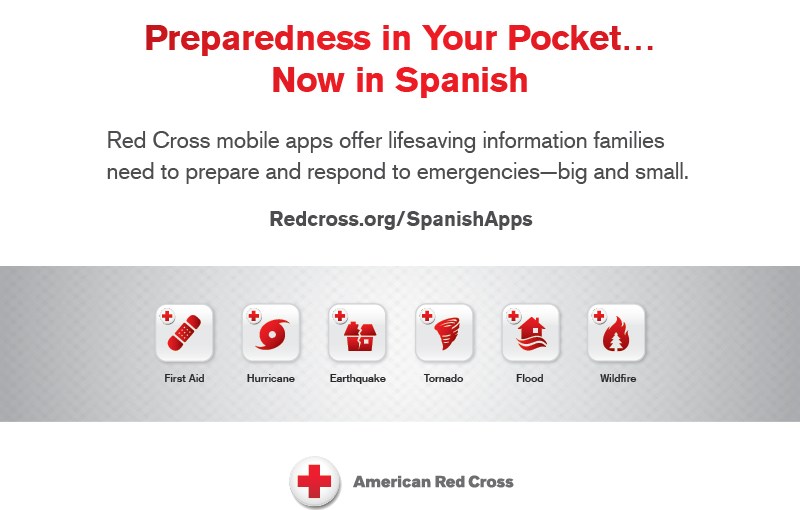
The six Spanish-language apps are the Red Cross First Aid, hurricane, tornado, earthquake,wildfire and flood apps. The Red Cross First Aid App gives people instant access to expert advice for everyday emergencies. The five Red Cross disaster preparedness apps give people local and real-time information for severe weather or disaster threats, and offer step-by-step instructions that let users know what to do before, during and after a hurricane, tornado, earthquake, wildfire and flood.


The Red Cross apps of special importance to people in Northern California are: First Aid, Emergency, Wildfire, Swim, Pet First Aid, Blood Donor and Youth.


The Red Cross apps have a feature that enables users to easily toggle between English and Spanish language on their app. Previously, users needed to set their entire phone language to either English or Spanish. The Red Cross, with its experience working with people during disasters, knows that people behave differently when under stress – such as a First Aid emergency or a weather emergency. In these times, people want to consume important information in the language they are most comfortable with. The Spanish toggle makes the life-saving information in the apps easier to get in emergency situations.


Each one of these Spanish-language apps are free and available for iPhones and Android devices in the Apple App Store and the Google Play Store. They can also be found at RedCross.org/SpanishApps (English) or RedCross.org/AppsenEspanol (Spanish).


All the apps offer pre-loaded content ensuring that Red Cross guidance is available anytime, anywhere – even if no Internet connection is available. Another important feature in the disaster preparedness apps allows users to let family and friends quickly know they are safe with a customizable “I’m Safe” alert for Facebook, Twitter, email and text. The apps also have interactive quizzes allow people to earn badges that they can share with friends on social networks.


The Red Cross created and released the six Spanish-language mobile at a time when smartphone use among Hispanics is surging. A 2013 study by the Pew Research Center found that Latinos own smartphones and go online from a mobile device at similar – and sometimes higher – rates than other groups of Americans.


“With natural disasters, it’s vital that people can receive and share warnings, preparedness information and their own status immediately with their social networks, and that’s what these Red Cross apps do,” Wyatt said. “If people can take only one step to make their family better prepared for disasters, they should download these free Red Cross apps and help their loved ones download them too.”


These six free Spanish-language apps build on the Red Cross legacy of teaching life-saving skills to people across the country. Overall, the award-winning Red Cross apps have been downloaded more than 4.7 million times.


The Red Cross is an established leader in teaching people the skills they need to survive life’s emergencies, and wants people to be ready to respond to emergencies and spread emergency information on their social networks, anywhere, anytime – even if they don’t have formal training.


While apps can prepare people for disasters, it’s important to remember that downloading any of the Red Cross apps is not a substitute for training. To learn more about Red Cross First Aid and CPR/AED courses or to register, visit redcross.org/TakeAClass.


About the American Red Cross:
The American Red Cross shelters, feeds and provides emotional support to victims of disasters; supplies about 40 percent of the nation’s blood; teaches skills that save lives; provides international humanitarian aid; and supports military members and their families. The Red Cross Gold Country Region serves 24 counties from San Joaquin to the Oregon Border and it’s a not-for-profit organization that depends on volunteers and the generosity of the American public to perform its mission. For more information, please visit RedCross.org/GoldCountry or visit us on Twitter at @RCSierraDelta or @RedCrossNECal.