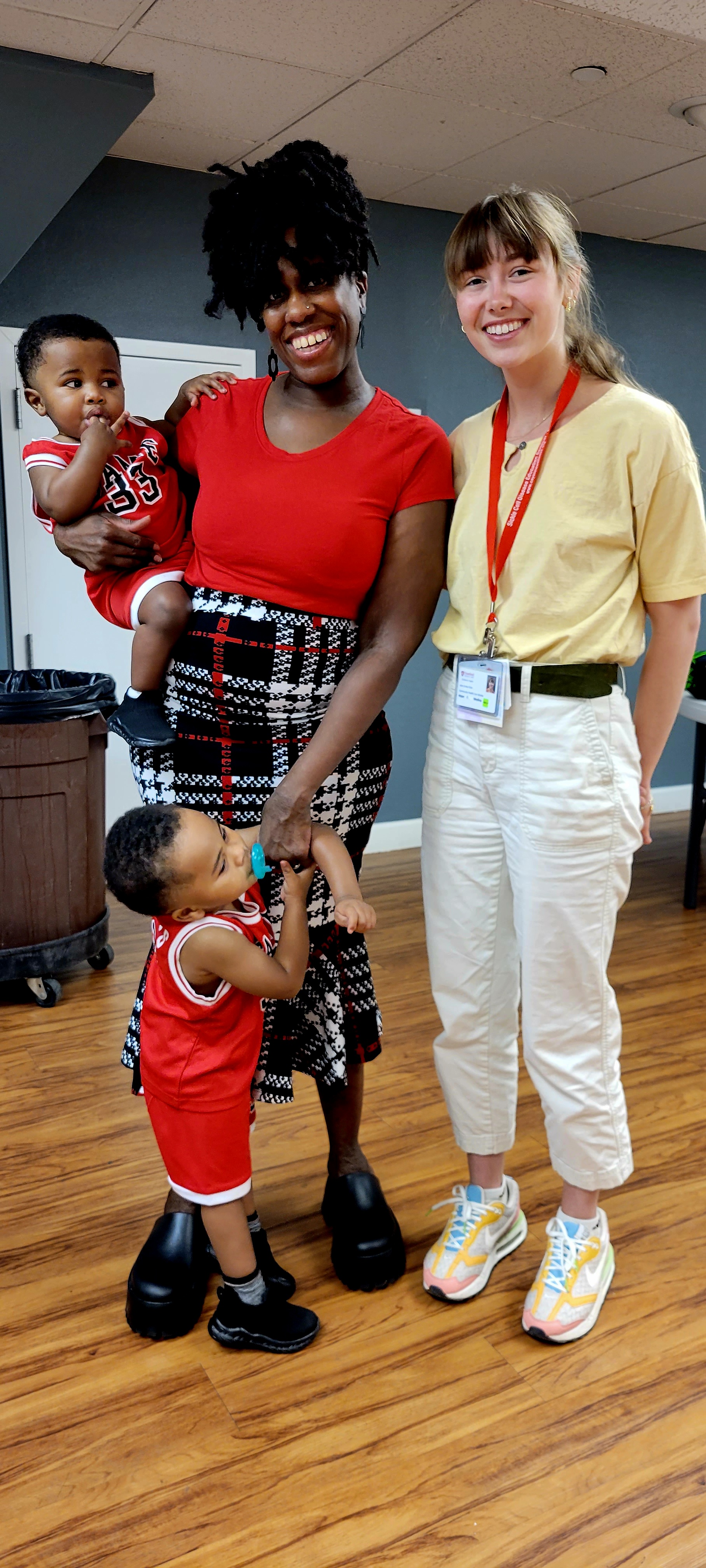
Tashamia Barrow, with her sons, Ike and Isiah, talks to Hope Media of the Cayenne Wellness Center. (Photo by Laurie Puglia)
By Stephen Walsh
A recent American Red Cross blood drive in Sacramento was a special day for Tashamia Barrow and her two young sons. Not only was it to be Tashamia’s first time donating blood, but she was there in support of her two young sons who are dealing with sickle cell disease.
The drive, held in partnership with the Cayenne Wellness Center and the Center of Praise Ministries, was organized to to bring awareness to the Red Cross Sickle Cell Initiative and hopefully find donors whose blood can be used to treat the disease.
Our regional partner SMUD is proud to sponsor the Red Cross Sickle Cell Initiative.
Tashamia said her one-year-old son, Isiah, has full-blown sickle cell disease and her two-year-old son, Ike, has the sickle cell trait but no symptoms. “Knowing what he’s going to go through when he’s getting older – that’s what’s inspiring me to donate, Tashamia said, looking at Ike.
When people donate blood, the blood is tested for specific antigens that are needed to treat sickle cell disease. If the blood contains those characteristics, the Red Cross notifies those donors so they can help sickle cell patients by donating whole blood, plasma, or platelets.
Learn more about the Red Cross Sickle Cell Initiative here.
“I didn’t know the effect my blood can have. Now that I know, I’m encouraging others to donate to save lives,” Tashamia said, thanking the Cayenne Wellness Center for helping to educate her about the disease.
Visit redcrossblood.org to schedule your blood donation. You can also make a financial donation in support of the Red Cross at redcross.org/donate.
Jah’Sear Lusk, 10, is a sickle cell anemia patient in the Sacramento area. His family encourages people to donate blood at redcrossblood.org to see if they have antigens that can be used to treat the disease.
Editor’s note: September was Sickle Cell Awareness Month, a time when the American Red Cross emphasizes the importance of a diverse blood supply to help meet the needs of those with sickle cell disease – the most common inherited blood disorder in the U.S. Since the California Gold Country Region’s social media space has been so focused on the wildfires that have ravaged much of Northern California, we chose to wait until now to share Jah’Sear Lusk’s story to give it the attention it deserves.
By Robin Blomster, Volunteer
Sickle cell anemia is an insidious disease. It sneaks around in deformed blood cells, painfully blocking oxygen, creating clots and affecting the body’s ability to fight infections. And it’s not satisfied with a physical toll – it wreaks havoc on the mental health of a patient and their community, too.
Jah’Sear was born with sickle cell anemia (SCA), and the physical and mental challenges have shaped his life and the lives of his Northern California family for nearly a decade.
“From ages 1 to 3, he was always sick,” said Jah’Sear’s mom, Andrea Lusk. She kept a “go bag” in the car because of the frequency with which she was visiting doctors.
“When you’re immune compromised, you catch viruses and infections easily. And SCA patients (are kept for) 72 hours … to run tests, take labs, and make sure … antibiotics are working. Every month and a half I was (in the hospital).”
The most serious complication of Jah’Sear’s illness hit him when he was just 3 years old.
“He had a bad virus. His fever never broke,” Andrea said. “His body became very inflamed, and then he had a massive ischemic stroke when he was 3, in 2016.”
Because he was 3, he’s had remarkable “get back,” how Andrea terms his recovery. He had to learn how to walk, talk and eat again. He was left with physical disability, mental/cognitive disability and vision impairment, and he’s a fall risk.
“He’s struggling. I’m getting him all the help he can get. It’s a struggle for him and he has a lot of self awareness (at this age). He asks, ‘Why did God let this happen to me?’ It was the hardest thing to answer. I knew it was coming. I ask God to give me the words to say to him to continue to build his confidence.”
Andrea has made it her life’s work to advocate for her son. She says she’s grateful to have her “village,” which includes her husband, William; her mom, Linda Castro; and her aunt, Patricia Franklin, who is a retired UC Davis registered nurse. But even so, it’s not easy.
When you donate, blood is tested for specific antigens that are needed to treat sickle cell disease. If your blood contains those characteristics, the Red Cross will let you know so you can help sickle cell patients by donating whole blood, plasma or platelets.
“We both work, we’re both self employed, which is amazing because at any given minute I have to drop everything to go be there with him. My husband doesn’t get to go to work, I don’t get to go to work (when Jah’Sear needs support),” Andrea said. “There are mental health ramifications for everyone involved. I can’t imagine other families and what they’re going through when I already know what I’m going through.”
Jah’Sear’s ongoing treatment is blood exchanges every five weeks, which are done through an apheresis machine. Many patients get transfusions, Andrea said, but she advocated for Jah’Sear to have apheresis because it pulls out a portion of the patient’s blood while giving them new blood.
“It’s like an oil change,” she said.
While there are promising treatments on the horizon, like DNA editing, for now because of Jah’Sear’s medical conditions he relies on blood.
“It’s life threatening. People with sickle cell wouldn’t be able to survive without blood donors. And we greatly appreciate it.”
Sickle cell is the most common inherited blood disorder in the United States and affects individuals of various racial and ethnic backgrounds. The majority are of African descent, and blood from donors of the same race or similar ethnicity is important in ensuring the best results, with the least potential reaction.
When you donate, blood is tested for specific antigens that are needed to treat sickle cell disease. If your blood contains those characteristics, the Red Cross will let you know so you can help sickle cell patients by donating whole blood, plasma or platelets.


 Gold Country News and Notes