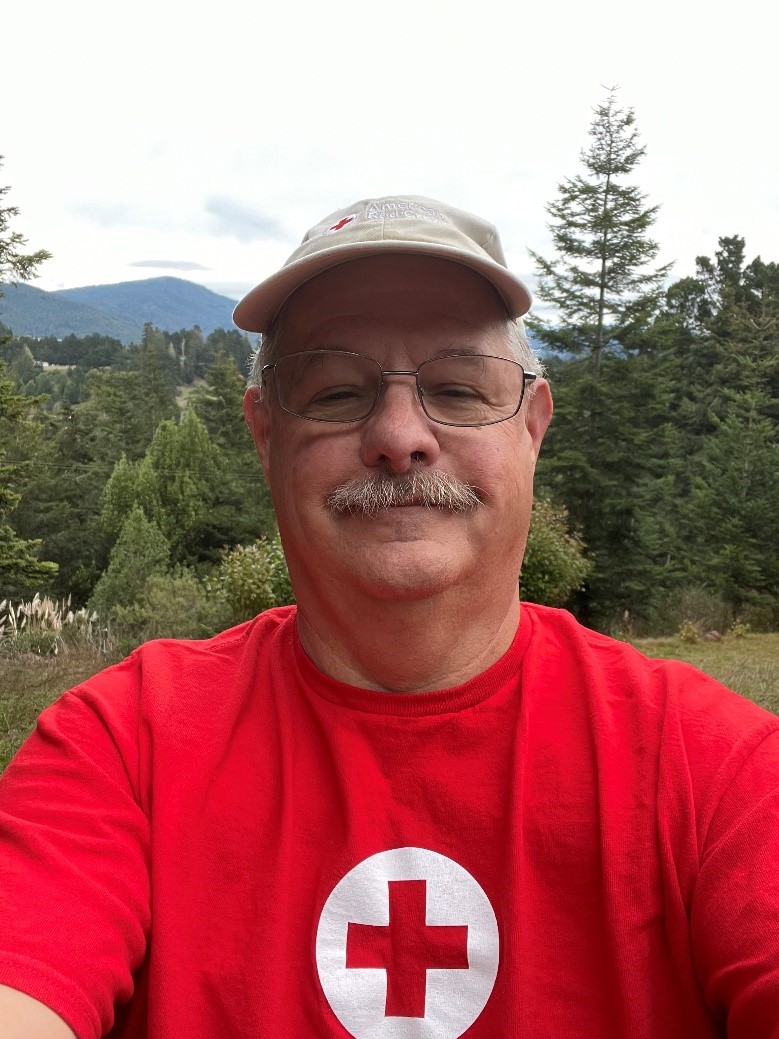
California Gold Country Region volunteer Darren Courtney has been honored with the Spirit of the Pacific Award for the month of December.
Courtney, whose regional volunteer roles include Sheltering Coordinator, Yuba/Sutter territory Disaster Action Team Lead, and Communications team photographer, has been a Red Cross volunteer for more than 25 years.
“He has consistently answered the call to deploy more than any other volunteer that is in my territory,” noted Community Disaster Program Manager Daryl White, who nominated Courtney for the award.
“Darren embraces all of our core values and delivers our mission with the upmost compassion and respect for our clients, those who have been displaced by a disaster and are probably at one of the lowest times in their lives. Several years ago, Darren saved a life in the shelter he was working in by giving a client Narcan, he recognized the need and stepped in.”
All Red Cross team members are encouraged to work together and personify a set of cultural values and behaviors that exemplify these Pacific Division ideals. The Spirit of the Pacific Award is specifically designed to acknowledge and reward these outstanding efforts on the part of employees and volunteers.
Northwest Region Community Disaster Program Manager Kelsey Smith deployed has alongside Courtney. In his nomination she said, “Darren has truly been one of the most impactful relationships that I have made on any deployment and probably throughout my entire time in the organization I think I can speak for many others, as well. When I think of my ideal version of a Red Crosser, Darren is the first person who comes to mind.”
In a note to the California Gold Country Region, Courtney said, “I am deeply honored to have received the Spirit of the Pacific Award from you and our amazing organization. This recognition is a testament to the shared efforts, unwavering dedication, and tireless spirit of the American Red Cross. I couldn’t do it without the support of leadership, staff, and fellow volunteers.”
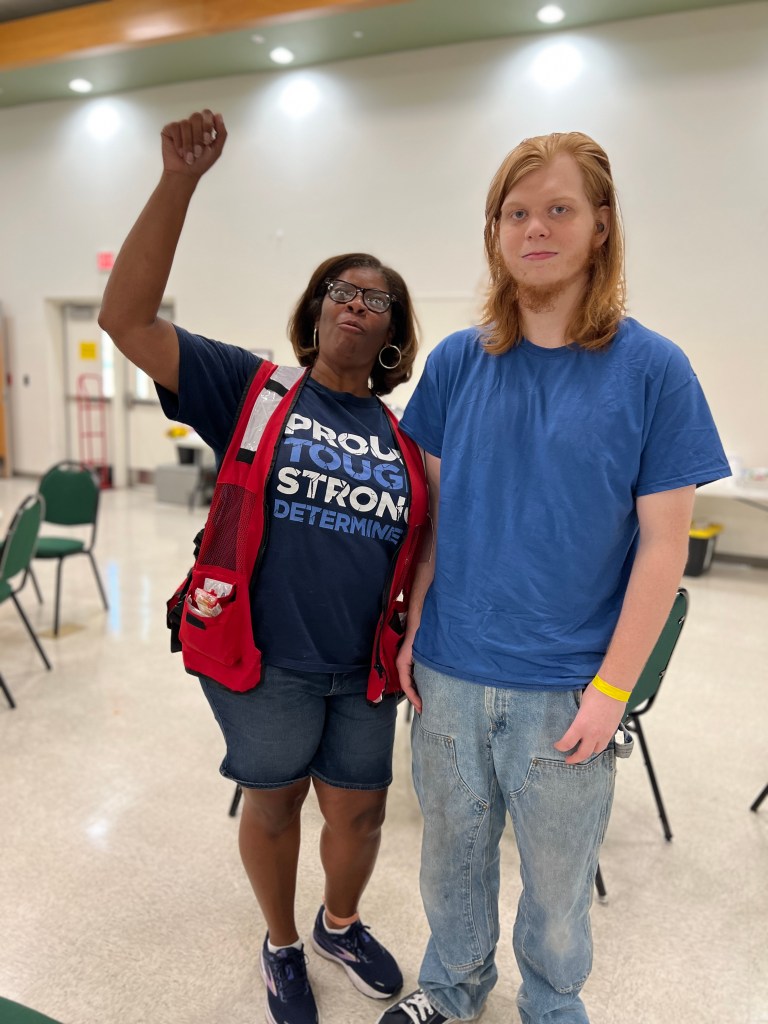
Carla A. Gunning celebrating the birthday boy, Harley Johnson
On a recent day inside the Red Cross Shelter in Cameron Park, volunteers helped one young man celebrate his 20th birthday. Harley Johnson and his family evacuated from the mountain community of Volcanoville during the Crozier Fire. Staff and shelter workers arranged for birthday cake and a balloon and sang “Happy Birthday”. One volunteer drew Harley out of his shyness, dancing and singing with enthusiasm. “I’m real big on morale-boosting,” says Carla A. Gunning. “When people are in a situation like this, it’s easy to get discouraged, to feel lost, not having that sense of normalcy or routine.”
Carla first volunteered for the Red Cross during Hurricane Katrina. Then, after time in the military, she recently returned to the Red Cross.
Carla has a message for anyone who is thinking of volunteering for the Red Cross. “Just do it! It’s very rewarding, and you’re able to see the difference you can make in peoples’ lives, whether it’s getting them something to eat, or giving them a hug or a smile, or saying ‘Hey! happy birthday!’”
If you are interested in volunteering with the Red Cross, visit redcross.org/volunteer or call 1-800-REDCROSS.
Red Cross volunteer, Carla A. Gunning | Photography by: Marcia Antipa, American Red Cross
By Michelle DeMeyer, Sierra-Delta Chapter Board and Tiffany Circle Member
Michelle DeMeyer visiting a Park Fire evacuation shelter at the Neighborhood Church in Chico. Michelle is a proud member of our Sierra-Delta Chapter Board of Directors and a member of the American Red Cross Tiffany Circle.
As a Red Cross Sierra-Delta Chapter Board member, and member of the Tiffany Circle, I felt an immense duty to assist wherever possible. My deep roots in the community—born in Butte County and raised in Glenn County—only intensified this drive. With multiple siblings living in Chico, including a brother just two and a half miles from the evacuation line, the fire’s impact was personal and immediate.
This wasn’t my first experience aiding fire victims in Butte County. In 2018, during the Camp Fire which had a devastating impact on the town of Paradise, I volunteered with World Central Kitchen, preparing and delivering food bags to first responders and evacuees in hotels. The Camp Fire’s devastation, where many of my friends lost everything, remains a poignant memory. The Park Fire served as a stark reminder of how swiftly tragedy can strike.
My experience during the Park Fire also fueled my determination to learn more about fire prevention and emergency response. I realized the importance of community preparedness and the need for timely evacuation plans. Witnessing the resilience and unity of the affected communities further strengthened my commitment to volunteer work and disaster relief efforts. The Park Fire incident prompted me to collaborate with local organizations to organize fundraising events and awareness campaigns, aiming to support both individuals affected by the disaster and the ongoing wildfire prevention initiatives. It’s crucial to channel the lessons learned from these tragic events into proactive measures that can help communities better anticipate and respond to future wildfires.
The Park Fire began on July 24, 2024, in the dry and dense vegetation near Bidwell Park, east of Chico. Triple-digit temperatures and high wind gusts fueled the explosive growth of the fire. By Saturday, July 27, the fire had ravaged 350,000 acres with zero percent containment. Mandatory evacuations were ordered for tens of thousands of residents in Butte, Shasta, and Tehama counties, prompting the rapid establishment of Red Cross- and county-managed shelters.
On Saturday, my wife and I arrived at the Neighborhood Church shelter in Chico, ready to assist. We joined the onsite Red Cross team just before lunch, helping to organize and distribute meals to those in need. Due to an increased number of evacuation orders, the shelter was quickly filling up with additional evacuees, which meant we needed more meals than originally planned. Thankfully, we have partners, like World Central Kitchen who could quickly deliver additional lunches, ensuring everyone was fed. Collaboration and planning among organizations like this helps ensure the community needs are met.
Amidst the tragedy, while some people chose to camp in the parking lot and come inside when needed for resources, other individuals sought refuge inside the shelter on cots. One man, lying on a cot and quietly crying, caught my attention. Kneeling beside him, I asked how he was doing. “I’m just happy to be alive and have my photos. It is all I have left,” he said.
Listening to his story, I learned this was not his first evacuation. He had also been displaced during the Camp Fire in 2018. Together, we shared tears and heartfelt moments that will forever hold a special place in my heart.
These are the moments where the Red Cross mission is fulfilled—when compassion, connection, and community come together in unexpected ways.
Throughout 2023, we are introducing you to the board of directors for our Sierra-Delta and Northern California chapters.
We begin with current Chair of the Sierra-Delta board, Roxanne Gould, who first came in contact with the Red Cross as a child when her family survived a home fire.
Roxanne, who is president of her firm Gould Government Relations, has been a member of American Red Cross Gold Country Region Board of Directors since 2016 and was appointed Board Chair in 2022.
When she was five years old, Roxanne lived through an apartment fire that she says was only survivable because of the quick thinking of her brother who saved both Roxanne and her mother.
She remembers sitting in a car watching their home burn to the ground and recalls Red Cross volunteers placing a blanket around her shoulders and giving her mom money for food, motel and other necessities.
Roxanne considers the Red Cross volunteers who helped her family that night as her heroes.
Roxanne has been driven to support the work of the California Gold Country Region through her work on the Board of Directors, and by volunteering her time with Sound the Alarm, the Pillowcase Project, various telethons and blood drives. She is also a member of the Red Cross Tiffany Circle, a community of women leaders who carry on Red Cross founder Clara Barton’s legacy by advancing the Red Cross mission through a focused investment of time, talent and treasure.
“I am always moved by the generosity of our donors in times of trouble. Donors know and understand the work of the Red Cross. I certainly do and will continue to give back for the rest of my life,” she says.
We thank Roxanne for her continued work on behalf of the Red Cross.
This information was last updated on Saturday, Jan. 14 at 8:00 a.m.Please check back regularly for updates.
Flooding, along with the potential for power outages and landslides, will impact the state through this weekend into next week. The American Red Cross has mobilized resources and is collaborating with government and community partners to respond to this storm. Nearly 400 Red Cross workers from across the country, along with shelters and supplies, have been activated to accommodate residents evacuated from their homes.
This online story map offers a look at the ongoing response to California floods; this map is updated as more information and stories from the ground are available.
Statewide Red Cross, County and Partner Shelter Information by County:
Everyone is welcome at a Red Cross shelter. All Red Cross disaster assistance is free.Current list denotes open shelters managed and/or supported by the Red Cross, county or community partners.
Amador County
Evelynn-Bishop Hall (located in Charles Howard Park)
Pack your emergency kit, know your routes and destinations, and listen to the advice of emergency officials. Download the free Red Cross Emergency app for real-time weather alerts, open Red Cross shelter locations and expert advice on storms and flooding. Search “American Red Cross” wherever you download apps or go to redcross.org/apps.
Flooding Safety
Stay off the roads and away from floodwaters. If you must drive, avoid flooded roadways. If power lines are down, call 9-1-1 and don’t approach or step in any puddles or standing water near the downed lines.
Follow evacuation orders and don’t return home until officials say it is safe to do so.
Use caution when cleaning up your home and wear protective clothing, including rubber gloves and boots. Throw out items that absorb water and can’t be disinfected, and dispose of all food, drinks and medications that have either spoiled or been damaged.
The Red Cross is working to maintain a stable blood supply amid the threat of storms and winter weather across the country, as severe weather often causes widespread blood drive cancellations. Where it is safe to do so, we encourage donors to make and keep blood donation appointments by using the Red Cross Blood Donor App, visiting redcrossblood.org or calling 1-800-RED CROSS (1-800-733-2767).
Help Those in Need
You can help people affected by disasters like storms and countless other crises by making a gift to American Red Cross Disaster Relief. Visit redcross.org, call 1-800-RED CROSS (800-733-2767), or text the word REDCROSS to 90999 to make a $10 donation.
Sign Up to Volunteer
While volunteering needs are in flux as the current weather event passes through our region, we are likely going to need more volunteers to support our response in the coming days. Be on the lookout for more information on ways you can help as needs evolve!
Stay Up-to-Date on Social Media
Updated information on the Red Cross response to this storm, and preparedness information is continually updated on regional social media channels. Find us on Twitter, Facebook and Instagram @ARCGoldCountry. We’re on LinkedIn here.
Mark Mowrey is a volunteer nurse with the California Gold Country Region of American Red Cross.
By Nate Russell, Disaster Program Manager
Mark Mowrey is a retired nurse and spends much of his time with the American Red Cross plying his skills as a Disaster Health Services volunteer.
When disaster struck Mark’s community in southern Humboldt County this week, Mark donned his Red Cross vest and sprung to action.
Shortly after Mark arrived at the shelter, a woman had registered for assistance who was visibly distraught. As Mark observed her talking with the shelter staff, he could see that she was becoming overwhelmed with worry so he did exactly what he did with his patients in his former job as a nurse. He sat down with her and asked her to tell her story.
The 6.4-magnitude earthquake had shaken a pipe free from her water heater and had started to leak water all over her basement. For some, this might be a minor inconvenience and a quick fix, but for a disaster evacuee, there are myriad invisible compounding stressors that can make even the smallest problems seem daunting.
“I’ve done it many times in the ER and in the Red Cross,” Mark said. “Asking people to tell their story relieves some of that pressure that they are feeling. It allows them to vent, to process, and to problem solve.”
The woman was able to start at the beginning and tell Mark about all the factors, large and small, that were contributing to her stress. It all culminated to a broken water heater that she hadn’t the slightest idea how to fix.
“She told me what kind of water heater she had, so I was able to help her figure out what part she needed, and gave her directions to a local hardware store.”
Armed with a plan and a clear path forward, the evacuee’s spirits were visibly raised as she set out from the shelter.
“That’s what I love about being a nurse and what I love being a Red Cross volunteer,” Mark said. “I love helping people find a pathway to help solve their problems. It feels good to help someone else tackle that overwhelming dilemma so they can take back that sense of control and, well, take a shower!”
Consider supporting our volunteer nurses and our disaster responders in your community by making a donation today. You can also sign up to volunteer!
Jah’Sear Lusk, 10, is a sickle cell anemia patient in the Sacramento area. His family encourages people to donate blood at redcrossblood.org to see if they have antigens that can be used to treat the disease.
Editor’s note: September was Sickle Cell Awareness Month, a time when the American Red Cross emphasizes the importance of a diverse blood supply to help meet the needs of those with sickle cell disease – the most common inherited blood disorder in the U.S. Since the California Gold Country Region’s social media space has been so focused on the wildfires that have ravaged much of Northern California, we chose to wait until now to share Jah’Sear Lusk’s story to give it the attention it deserves.
By Robin Blomster, Volunteer
Sickle cell anemia is an insidious disease. It sneaks around in deformed blood cells, painfully blocking oxygen, creating clots and affecting the body’s ability to fight infections. And it’s not satisfied with a physical toll – it wreaks havoc on the mental health of a patient and their community, too.
Jah’Sear was born with sickle cell anemia (SCA), and the physical and mental challenges have shaped his life and the lives of his Northern California family for nearly a decade.
“From ages 1 to 3, he was always sick,” said Jah’Sear’s mom, Andrea Lusk. She kept a “go bag” in the car because of the frequency with which she was visiting doctors.
“When you’re immune compromised, you catch viruses and infections easily. And SCA patients (are kept for) 72 hours … to run tests, take labs, and make sure … antibiotics are working. Every month and a half I was (in the hospital).”
The most serious complication of Jah’Sear’s illness hit him when he was just 3 years old.
“He had a bad virus. His fever never broke,” Andrea said. “His body became very inflamed, and then he had a massive ischemic stroke when he was 3, in 2016.”
Because he was 3, he’s had remarkable “get back,” how Andrea terms his recovery. He had to learn how to walk, talk and eat again. He was left with physical disability, mental/cognitive disability and vision impairment, and he’s a fall risk.
“He’s struggling. I’m getting him all the help he can get. It’s a struggle for him and he has a lot of self awareness (at this age). He asks, ‘Why did God let this happen to me?’ It was the hardest thing to answer. I knew it was coming. I ask God to give me the words to say to him to continue to build his confidence.”
Andrea has made it her life’s work to advocate for her son. She says she’s grateful to have her “village,” which includes her husband, William; her mom, Linda Castro; and her aunt, Patricia Franklin, who is a retired UC Davis registered nurse. But even so, it’s not easy.
When you donate, blood is tested for specific antigens that are needed to treat sickle cell disease. If your blood contains those characteristics, the Red Cross will let you know so you can help sickle cell patients by donating whole blood, plasma or platelets.
“We both work, we’re both self employed, which is amazing because at any given minute I have to drop everything to go be there with him. My husband doesn’t get to go to work, I don’t get to go to work (when Jah’Sear needs support),” Andrea said. “There are mental health ramifications for everyone involved. I can’t imagine other families and what they’re going through when I already know what I’m going through.”
Jah’Sear’s ongoing treatment is blood exchanges every five weeks, which are done through an apheresis machine. Many patients get transfusions, Andrea said, but she advocated for Jah’Sear to have apheresis because it pulls out a portion of the patient’s blood while giving them new blood.
“It’s like an oil change,” she said.
While there are promising treatments on the horizon, like DNA editing, for now because of Jah’Sear’s medical conditions he relies on blood.
“It’s life threatening. People with sickle cell wouldn’t be able to survive without blood donors. And we greatly appreciate it.”
Sickle cell is the most common inherited blood disorder in the United States and affects individuals of various racial and ethnic backgrounds. The majority are of African descent, and blood from donors of the same race or similar ethnicity is important in ensuring the best results, with the least potential reaction.
When you donate, blood is tested for specific antigens that are needed to treat sickle cell disease. If your blood contains those characteristics, the Red Cross will let you know so you can help sickle cell patients by donating whole blood, plasma or platelets.
Bob Dunham and Patty Girdner evacuated from Yreka and got acquainted through their stay at the Red Cross shelter in Weed. Neither had been in a situation of needing to shelter away from home previously, so they had no idea what to expect when they got there.
Bob and Patty both said they have been “blessed and amazed” by the care they have gotten from the Red Cross volunteers.
Bob, who has lived in Siskiyou County for 44 years, was not in an area of town that was under a mandatory evacuation, but the unpredictability of the situation and his health concerns affected by the smoke brought him to the shelter.
While he was at the shelter, Bob’s dog, Scooter, was being cared for at the Rescue Ranch dog shelter. His growing up as a military dependent and going through earthquake drills when he was a kid in Japan and Hawaii taught him to be prepared always to “go on a moment’s notice.”
Patty was in a similar situation as Bob. She said she would love to be a volunteer when she gets back on her feet, health-wise. Patty said she is very grateful for the support she has received at the Red Cross shelter.
“I’ve never seen the over-abundance of giving like this. I want to volunteer and give back.”
Both Patty and Bob repeatedly expressed how much they appreciated having the shelter available. Both could often be seen trying to help out in some way around the shelter.
Bob said, “I’m happy for what little I’ve been able to do around the shelter.”
“We’re all in the same boat. Everybody has come together,” said Patty. “We are all helping each other.”
As Bob and Patty talk about their evacuation experiences, they remain hopeful and eager to get back to their homes. They both noted, “It’s all about perspective,” that “choosing to live in Siskiyou County means choosing to live with the possibility of wildfire.”
Bob said, “Everyone encounters disasters. Each area has its own kind of potential disaster. How you get through it is with the relief from the Red Cross and other organizations – the people showing up just to make donations was unbelievable. To be hands on with the Red Cross…you guys are wonderful.
“It’s the heart and empathy that makes people want to be Red Cross volunteers and do the amazing things you’re doing here.”
You can support Red Cross disaster relief efforts by making a financial donation at redcross.org/donate.
Diedre Cazneaux took it upon herself to run the kitchen at the Red Cross shelter in Siskiyou County.
By Judith Lester, Volunteer
Deidra Cazneaux’s deployment with the California Gold Country Region of the American Red Cross to the McKinney Fire was her first, but it wasn’t obvious.
The McKinney Fire in Siskiyou County displaced some 2,000 residents in late July. That’s when Cazneaux looked straight into the face of the disaster and went right to work.
“I just walked into the shelter kitchen and took over,” she said.
In her days at the shelter, Cazneaux always did her job with a smile, chatting with each evacuee and even advocating for them to ensure partner agencies who provided meals were offering nutritious options.
Shelter manager Bill Hart described Cazneaux, saying, “Deidra is an incredibly positive force in the face of controlled chaos.”
In recognition of her work at the shelter and her positive attitude while on the job, Cazneaux was presented with a Red Cross Disaster Cycle Services challenge coin.
“It’s always been in my heart to serve people,” Cazeneaux said, adding: “It’s an avenue for me to be who God wants me to be.”
Visit redcross.org/volunteer to explore the many opportunities to serve as a Red Cross volunteer.
Harlene Schwander lost her home in the McKinney Fire and regularly expressed her gratitude for the help she’s received since she evacuated.
By Judith Lester, Volunteer
Harlene Schwander hadn’t driven in years. But she drove herself to the American Red Cross Shelter at the Weed Community Center when her home was destroyed in Siskiyou County’s McKinney Fire.
Schwander was not shy about expressing her appreciation for people who gave her clothing, comfort and care while she was at our shelter.
She told her life story and the circumstances of her evacuation to several news reporters who visited the Weed shelter.
Schwander said she’s planning to volunteer for the American Red Cross after this experience.
“I am amazed at how much you help people mentally and physically— you just buoy people!”
“I am overwhelmed by your kindness,” Schwander said, adding that is why she is planning to join the Red Cross team.







 Gold Country News and Notes