Based at the Cohasset Community Association center in the town of Cohasset (elev. 2,500 ft.) for almost two weeks, Paul Jessen and his team of American Red Cross caseworkers embody deep compassion for the needs of hundreds of families displaced by the Park Fire. On July 24, 2024, the Park Fire ignited and became the 4th largest wildfire in California, according to CalFire, affecting the counties of Butte, Tehama, Shasta and Plumas. However, the Park Fire is only one of many large and small wildfires in the entire state since July.
Having been a volunteer for only a year so far, the Lincoln, California resident is a casework and disaster action team supervisor with the American Red Cross Gold Country Region which encompasses 26 counties in Northern California. Retired with an ample amount of free time has allowed Paul to become an active and busy volunteer.
A five to eight-hour shift for a caseworker entails looking for effective ways to address challenges facing residents who had to evacuate leaving most of their belongings behind, seeking shelter, then safely returning to their community trying to piece together what remains of their lives and livelihoods. Residents and caseworkers eventually concur on the disaster recovery plan which can include Red Cross assistance and referrals to other organizations.
Reflecting on his volunteer experience, Paul shared, “I found it amazing how much the local community appreciated us being there. How much it gave them serenity and stability. That they had not been left alone. When other organizations packed up, the Red Cross was still there offering help. Even when we were not providing much more assistance, we were thanked for just being there—IN CASE.”
His dedication to volunteering is clear, as he explains, “I am involved in a multitude of different volunteer organizations. Red Cross requires the greatest amount of time but also provides the greatest level of satisfaction and fulfillment.”
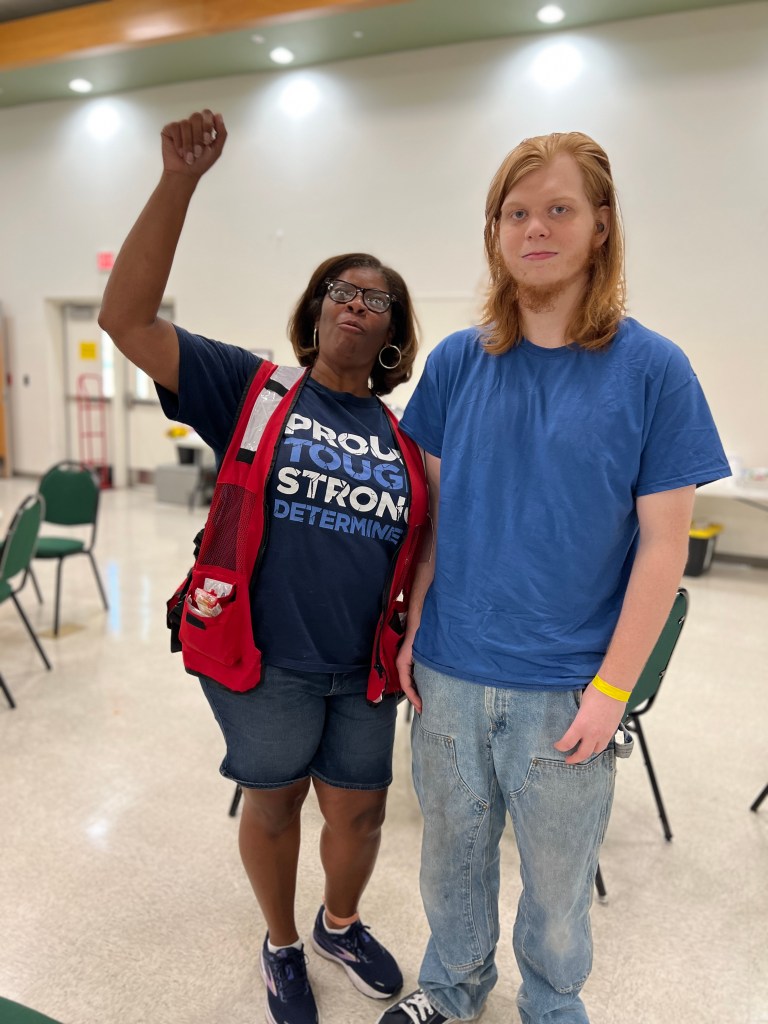
Carla A. Gunning celebrating the birthday boy, Harley Johnson
On a recent day inside the Red Cross Shelter in Cameron Park, volunteers helped one young man celebrate his 20th birthday. Harley Johnson and his family evacuated from the mountain community of Volcanoville during the Crozier Fire. Staff and shelter workers arranged for birthday cake and a balloon and sang “Happy Birthday”. One volunteer drew Harley out of his shyness, dancing and singing with enthusiasm. “I’m real big on morale-boosting,” says Carla A. Gunning. “When people are in a situation like this, it’s easy to get discouraged, to feel lost, not having that sense of normalcy or routine.”
Carla first volunteered for the Red Cross during Hurricane Katrina. Then, after time in the military, she recently returned to the Red Cross.
Carla has a message for anyone who is thinking of volunteering for the Red Cross. “Just do it! It’s very rewarding, and you’re able to see the difference you can make in peoples’ lives, whether it’s getting them something to eat, or giving them a hug or a smile, or saying ‘Hey! happy birthday!’”
If you are interested in volunteering with the Red Cross, visit redcross.org/volunteer or call 1-800-REDCROSS.
Red Cross volunteer, Carla A. Gunning | Photography by: Marcia Antipa, American Red Cross
Shelter supervisor David Risard and Feeding associate Jennie Risard made sure Park Fire evacuees staying at the Neighborhood Church site in Chico continued to have nourishment and a comfortable stay at the shelter.
No strangers to American Red Cross response and recovery activities, the husband-wife team from Santa Barbara have been American Red Cross volunteers for 20 years—and proud of their 20-year service pins as well as their 5-digit volunteer identification numbers!
Jennie recalls hearing a radio public service announcement about free training to become Red Cross volunteers. The Risards lived in Sonora (CA) at that time and began their volunteer tenure with the Sacramento chapter. “We always wanted to help people,” Jennie said. “When their children got older, that was our chance to spend more time as volunteers.”
How does it make them feel to respond to disasters over the years? The couple concurred that volunteering “is very meaningful work and you never know who might need help.” Dave said “it is satisfying to provide assistance to those displaced from home and needing shelter and food while they prepare to move forward.”
To encourage others to volunteer, Jennie said that their volunteerism has inspired other people who also realized there is a lot of need not only locally but all over the country. “Every little bit helps.”
“The Sheriff banged on my door at two in the morning and said to get out. I had a go bag all packed but forgot to bring it.”
Beverly Stevens evacuated her mountain home in Swansboro, CA, escaping the Crozier Fire that threatened her community. The fire started on August 6. She had to leave behind three cats and her horse.
The 81-year-old was staying at the now-closed Red Cross Shelter at the Cameron Park Community Center. She has an upbeat attitude, saying, “The food’s good here, and my daughter’s friend brought me a bag of my favorites – Reese’s Peanut Butter Cups!”
The Red Cross, along with partners from El Dorado County and the Salvation Army, provided hot food, a safe place to sleep and other services at this shelter.
American Red Cross volunteers continue to monitor fire activity all over California. If you would like to help those affected by the California Wildfires, visit redcross.org or call 1-800-RED-CROSS (1-800-733-2767).
By Nathaniel Millard, Community Disaster Risk Reduction Program Manager
There is an African proverb that says if you want to go fast, go alone; if you want to go far, go together. The American Red Cross Butte County Community Adaptation Program added that if you want to go fast together, you do that by building relationships.
The Red Cross’ Community Adaptation Program (CAP) is a new program aimed at building community resilience and empowering the community to mobilize during disaster.
The mission of the Red Cross is to prevent and alleviate human suffering in the face of emergencies by mobilizing the power of volunteers and the generosity of donors.
The Butte County CAP team has spent the last two years in the community identifying needs for community organizations to help build their capacity, capability, and continuity to operate during blue skies, but also to mobilize during response and recovery.
Most of this work has been about building relationships, healing, building trust, and listening.
To help aid food security, the community identified the need to grow more food. The Butte County Local Food Network is an organization that helps build community gardens and helps individuals install garden beds in their backyard. The Butte County Local Food Network, to increase their capacity to serve more gardens, needed a new truck and trailer. The Red Cross stepped in and purchased these things.
For all this work, all the Red Cross asks is to have these organization help during a disaster, and help is exactly what they did. During the Park Fire, when Raley’s donated food to the shelter, Butte County Local Food network stepped up and used their truck to go get the food and deliver to the shelter. When there wasn’t enough storage for food at the shelter, one of the food pantries, the South Chico Community Assistance Center, stepped in and let the Red Cross store food in their fridge for the shelter.
One of the needs identified surrounds building food security throughout Butte County. One of the ways to do this is through food pantries. When the Community Action Agency of Butte County, in partnership with 530 Food Rescue Coalition, identified the need to increase cold storage capacity, the American Red Cross stepped in and purchased over 30 new fridges and freezers around the county, including for seven new food pantry locations.
The Red Cross Butte County CAP team: Nathaniel Millard, Jake Fender and Amalia Rodas.
When the shelter needed freezer space for ice and frozen goods, Bethel AME Church let the American Red Cross move their freezer over to the Neighborhood Church to use it. And when there was left over food at the shelter after one of their meals, 530 Food Rescue came to the shelter, picked up the food and delivered the food to the Jesus Center for the unhoused.
These are just a few examples of the ways that the Red Cross is investing into communities and the communities are mobilizing to help disaster response and recovery, and we are doing this faster and together through the power of relationships.
“The Red Cross CAP team has been instrumental in assessing community needs and filling the identified gaps. They’ve been intentionally inclusive and equitable which has led to an unprecedented level of collaboration across Butte’s social service landscape,” said Timothy Hawkins, CEO of the Community Action Agency of Butte County.
“When we started 530 Food Rescue, we had a theory that an active food rescue network would be an asset to the community after a disaster, to make sure food resources are reaching those in need and not going to waste.”
“The recent fires in Butte County and especially the Park Fire have proven that theory to be true. The 530 Food Rescue team is honored to be of service directing surplus food resources to evacuation sites when appropriate and helping distribute the surplus food to area nonprofits as the shelter sites close,” said Sheila McQuaid, Project Director of the 530 Food Rescue Coalition.
“The American Red Cross shelter teams have so much going on, and yet it is clear that they hate to see good food going to waste. We are happy to take that worry off their plate!”
The Butte County CAP team helped to create the Butte Resilience Collaborative. If you want to participate, join the collaborative here. If you want to volunteer, join the Butte-Glenn VOAD. To donate to the Red Cross, visit redcross.org/donate.
By Michelle DeMeyer, Sierra-Delta Chapter Board and Tiffany Circle Member
Michelle DeMeyer visiting a Park Fire evacuation shelter at the Neighborhood Church in Chico. Michelle is a proud member of our Sierra-Delta Chapter Board of Directors and a member of the American Red Cross Tiffany Circle.
As a Red Cross Sierra-Delta Chapter Board member, and member of the Tiffany Circle, I felt an immense duty to assist wherever possible. My deep roots in the community—born in Butte County and raised in Glenn County—only intensified this drive. With multiple siblings living in Chico, including a brother just two and a half miles from the evacuation line, the fire’s impact was personal and immediate.
This wasn’t my first experience aiding fire victims in Butte County. In 2018, during the Camp Fire which had a devastating impact on the town of Paradise, I volunteered with World Central Kitchen, preparing and delivering food bags to first responders and evacuees in hotels. The Camp Fire’s devastation, where many of my friends lost everything, remains a poignant memory. The Park Fire served as a stark reminder of how swiftly tragedy can strike.
My experience during the Park Fire also fueled my determination to learn more about fire prevention and emergency response. I realized the importance of community preparedness and the need for timely evacuation plans. Witnessing the resilience and unity of the affected communities further strengthened my commitment to volunteer work and disaster relief efforts. The Park Fire incident prompted me to collaborate with local organizations to organize fundraising events and awareness campaigns, aiming to support both individuals affected by the disaster and the ongoing wildfire prevention initiatives. It’s crucial to channel the lessons learned from these tragic events into proactive measures that can help communities better anticipate and respond to future wildfires.
The Park Fire began on July 24, 2024, in the dry and dense vegetation near Bidwell Park, east of Chico. Triple-digit temperatures and high wind gusts fueled the explosive growth of the fire. By Saturday, July 27, the fire had ravaged 350,000 acres with zero percent containment. Mandatory evacuations were ordered for tens of thousands of residents in Butte, Shasta, and Tehama counties, prompting the rapid establishment of Red Cross- and county-managed shelters.
On Saturday, my wife and I arrived at the Neighborhood Church shelter in Chico, ready to assist. We joined the onsite Red Cross team just before lunch, helping to organize and distribute meals to those in need. Due to an increased number of evacuation orders, the shelter was quickly filling up with additional evacuees, which meant we needed more meals than originally planned. Thankfully, we have partners, like World Central Kitchen who could quickly deliver additional lunches, ensuring everyone was fed. Collaboration and planning among organizations like this helps ensure the community needs are met.
Amidst the tragedy, while some people chose to camp in the parking lot and come inside when needed for resources, other individuals sought refuge inside the shelter on cots. One man, lying on a cot and quietly crying, caught my attention. Kneeling beside him, I asked how he was doing. “I’m just happy to be alive and have my photos. It is all I have left,” he said.
Listening to his story, I learned this was not his first evacuation. He had also been displaced during the Camp Fire in 2018. Together, we shared tears and heartfelt moments that will forever hold a special place in my heart.
These are the moments where the Red Cross mission is fulfilled—when compassion, connection, and community come together in unexpected ways.






 Gold Country News and Notes